Meta Muse Wonder and Wonder Full: How Active Memory Compares With GPT and Claude
Key takeaways
- Meta released Muse Wonder and Wonder Full on Oct. 12, 2026, as proprietary models after years of open-source Llama.
- Muse Wonder costs $4/$20 per million tokens via API; Wonder Full needs a $50 or $200 Muse Code plan.
- Both models beat Opus 5.5 and GPT-6 Astra on MemoryBench; Wonder Full leads SWE-Marathon, but Opus wins Terminal-Bench.
Meta unveiled two new AI models, Meta Muse Wonder and Muse Wonder Full, on Oct. 12, 2026. After years of focusing on open-source AI built around Llama, Meta this time released a proprietary, high-end model.
What stands out is that it remembers earlier conversations and, when something goes wrong mid-task, looks for a fix and tries again.

Meta Muse Wonder: key features and pricing
Muse Wonder was built by Meta Superintelligence Labs, led by Alexandr Wang. It’s also the model behind Muse, Meta’s personal agent app, which passed 6.6 million global downloads within a month of launch.
It comes in two versions: the standard Muse Wonder and the higher-performance Muse Wonder Full. Both were pretrained and reinforcement-trained at Prometheus, Meta’s gigawatt-scale data center in Ohio, according to Meta’s announcement.
| Muse Wonder | Muse Wonder Full | |
|---|---|---|
| Context window | About 1.05 million tokens | About 1.05 million tokens |
| Input | Text, images, video, audio, PDF | |
| Access | API, Muse Code | Muse Code only |
| Price | $4 input / $20 output / $0.20 cached (per 1M tokens) | $50 or $200 per month |
It’s multimodal: besides text, it handles images, video, audio and PDF documents. The context window, the amount of input the model can consider at once, is about 1.05 million tokens. At roughly 1 million tokens, you can feed it a long document or a large codebase in one go.

How you access it depends on the model. The standard model is available through the Meta Model API and Muse Code, at $4.00 per million input tokens and $20.00 per million output tokens. Cached input costs $0.20.
Muse Wonder Full has no public API. You get it through a Muse Code subscription: Power Usage ($50/month) or Maximum Usage ($200/month).
Active Memory: it remembers earlier conversations
The feature to watch in this release is Active Memory. If you use AI a lot, you’ve probably had to re-enter work details or requirements you already explained. In a long chat, or when you open a new one, earlier context often doesn’t carry over properly.
Active Memory organizes your preferences, work requirements and project details from many conversations into a separate memory store. When a new question comes in, it finds the relevant information and uses it in the answer, a process called Active Retrieval.

Standard RAG (retrieval-augmented generation) searches for information related to a question and uses it in the answer. But what it retrieves doesn’t always fit the actual context of the conversation. Active Memory is designed to keep track of information that changed along the way, including updated requirements, in chronological order.

On MemoryBench, Meta’s internal test of long conversations of 64,000 to 100,000 tokens, Muse Wonder scored 85.6 and Wonder Full 85.5. Both beat Claude Opus 5.5 and GPT-6 Astra on the same test. Keep in mind, though, that a benchmark score doesn’t directly show how accurately the model remembers things in real use.
Active Focus: it keeps working when errors happen
The other headline feature is Active Focus. When an error occurs during a complex task, the model analyzes the cause and tries a different approach.
Say it hits a compile error while editing software that spans many files. Active Focus reviews the work, switches its implementation approach or fixes the code, and keeps going. That can help with long coding sessions or changes to a large codebase.
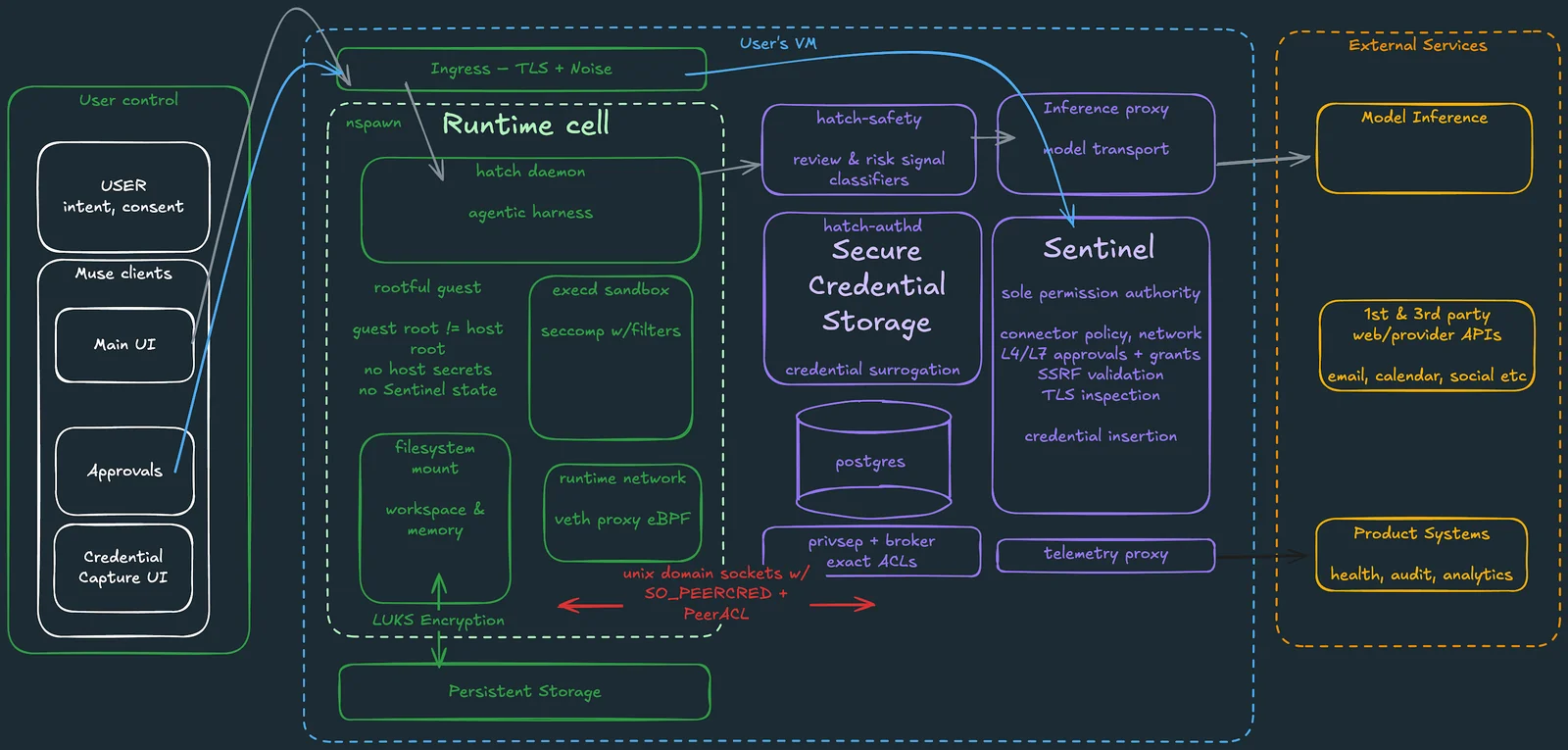
There’s a safeguard for user confirmation, too. Before high-impact actions, such as changing system settings or making external network calls, it asks you for approval.
Whether that process works reliably in real-world use still needs more testing.
Meta Muse Wonder vs GPT and Claude: benchmarks
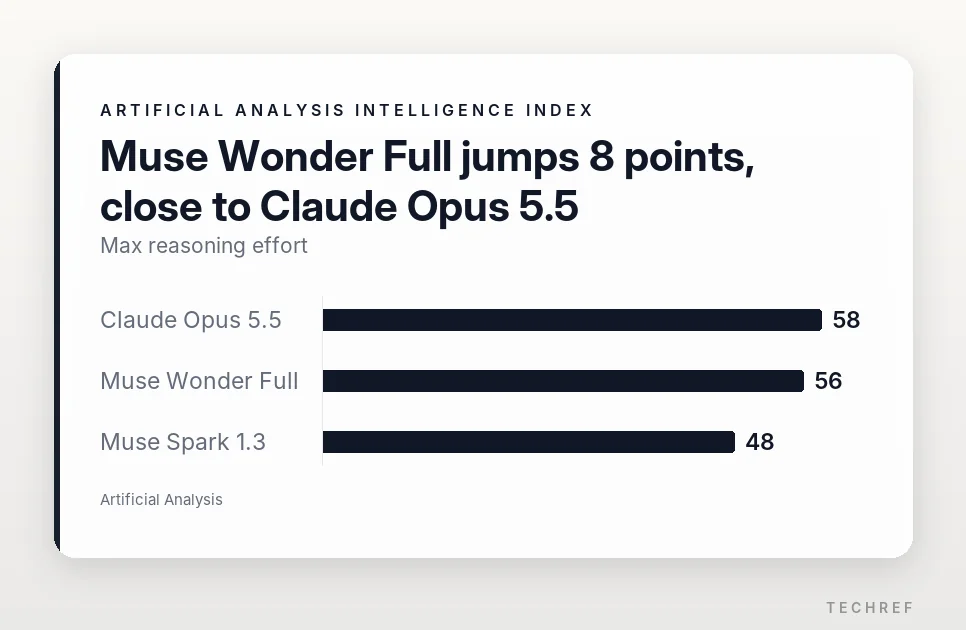
On the Artificial Analysis Intelligence Index, Muse Wonder Full scores 56. That’s 8 points above its predecessor, Muse Spark 1.3 (48), and close to Claude Opus 5.5’s 58.
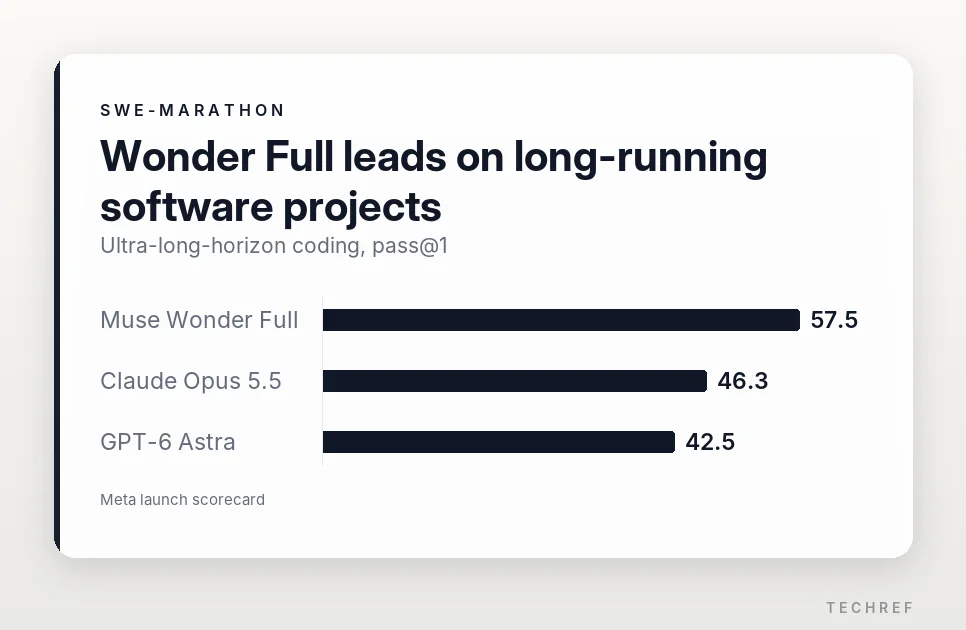
On SWE-Marathon, which tests long-running software development, Wonder Full scored 57.5. Claude Opus 5.5 scored 46.3 and GPT-6 Astra 42.5, so Meta’s model came out on top here. One caveat from Meta’s model card: the models ran in different agent setups, so this row is not a controlled, same-harness comparison.
It also scored 79.0 on DeepSWE 1.1, which tests editing across many files. It was also rated well on Harvey’s legal benchmark (Harvey LAB), which covers legal document work.

That doesn’t mean it leads everywhere. On Terminal-Bench 4.0, which tests command-line work, and HealthBench Pro, which covers professional medical knowledge, Claude Opus 5.5 scored higher.
Competing models also came out ahead on zero-shot code generation, writing code from scratch, and on tasks that operate a computer screen directly. So it’s best to compare the detailed results for the kind of work you have in mind.
Why Meta went proprietary
Meta’s AI business is shifting direction. It spent years growing an open-source ecosystem around Llama, but the Muse Wonder series keeps its model weights private and is offered through an API and paid subscriptions.
The top model, Wonder Full, has no public API, which makes it hard for companies and developers to plug it into their own services. The standard model is available via API, but the best performance requires a Muse Code subscription.

Safety testing is another thing to check. Meta says it applied safeguards against chemical, biological, radiological and cyber threats. Its model card summarizes the risk evaluations, but the full safety report was described as coming “soon” at launch.
When an AI works on its own for long stretches, unexpected errors or security problems can come up. So beyond raw performance, it matters whether user-approval steps and safeguards actually work.
Bottom line: will it hold up in real work?
Meta Muse Wonder stands out because it remembers earlier conversations and keeps going when errors happen. It also posted higher benchmark scores than rival models on long coding tasks, which makes it promising for complex development work.
That said, the top model, Wonder Full, has no public API, which limits where you can use it, and its safety record needs more scrutiny. If you’re weighing Meta Muse Wonder, test it on your own workload before trusting the benchmark numbers.
Related reading
- Gemini 4 Argon vs. GPT-6 Astra and Claude Opus 5.5: Benchmarks and API Pricing Compared
- Anthropic’s Q3 Revenue Hit $16.8 Billion. Why AI Bubble Fears Are Growing Anyway