AI Token Price War: How DeepSeek Is Pressuring OpenAI and Anthropic
Key takeaways
- DeepSeek V4.1 Flash costs $0.15/$0.60 per million tokens off-peak; GPT-6 Luna and Claude Haiku 5.5 are cheaper at $0.10/$0.50.
- DeepSeek wins on cache hits ($0.003) and cuts memory to 890 bytes of HBM KV cache per token.
- Compare cost per task, success rates and retries, not just token prices, before picking a model.
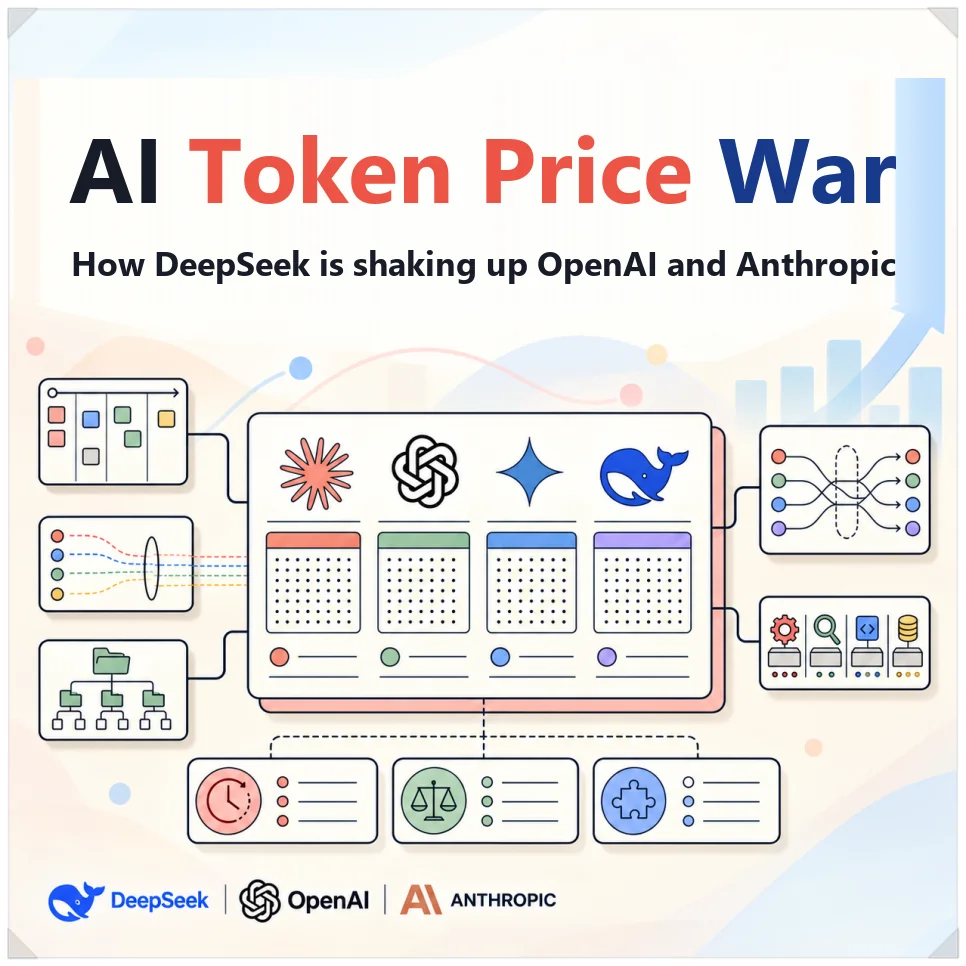
When you choose an AI model, the price matters as much as the performance. For services that call an API over and over, like AI agents, token prices can swing operating costs a lot. With AI companies shipping one cheap model after another, the price competition is heating up, and DeepSeek API pricing is at the center of it.
DeepSeek has drawn attention for its low API rates. Yet OpenAI’s and Anthropic’s price lists include models that are cheaper than DeepSeek. How DeepSeek brought its costs down explains why its rivals keep cutting prices too.
DeepSeek API pricing vs OpenAI and Anthropic: is it the cheapest?
AI model pricing is usually quoted per million (1M) tokens. Input, the tokens the model reads, and output, the tokens it writes, are priced differently, and there’s a separate cache rate for content the model reuses.
Here are API rates for the main models as of October 2026.
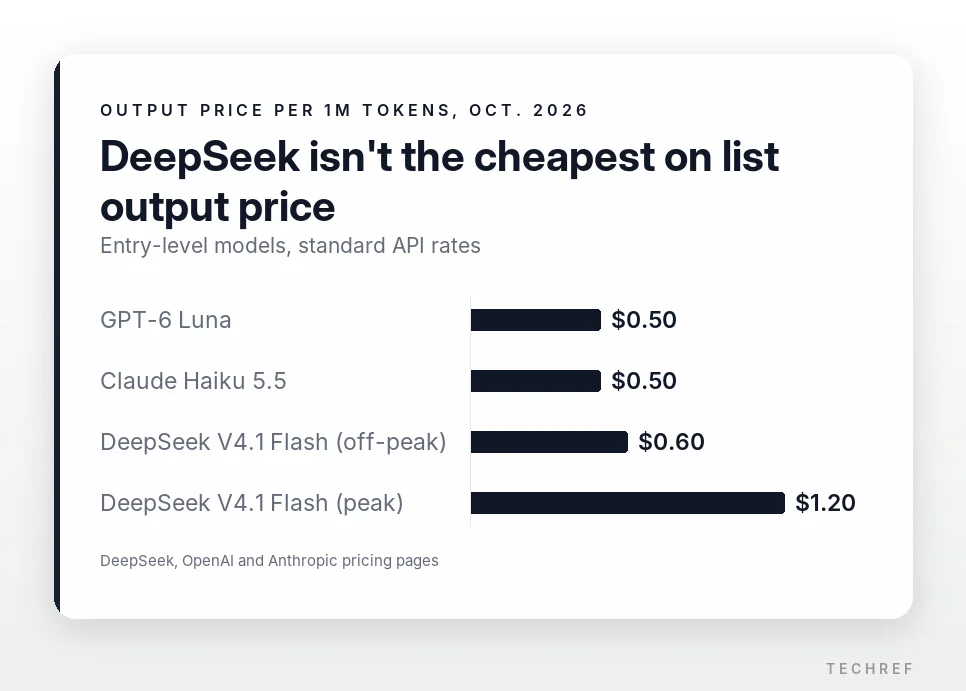
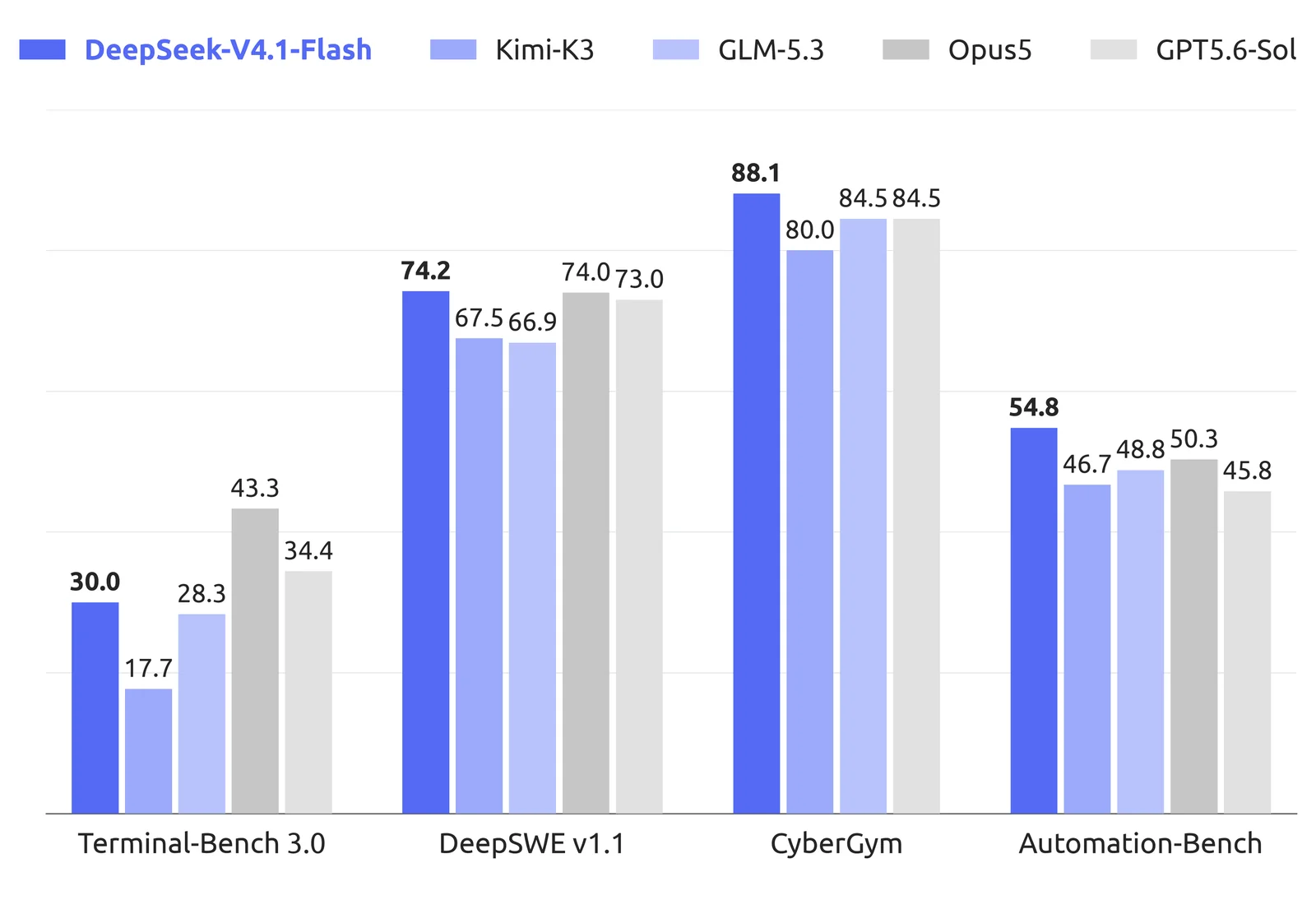
On base prices alone, GPT-6 Luna and Claude Haiku 5.5 charge less than DeepSeek for both input and output.
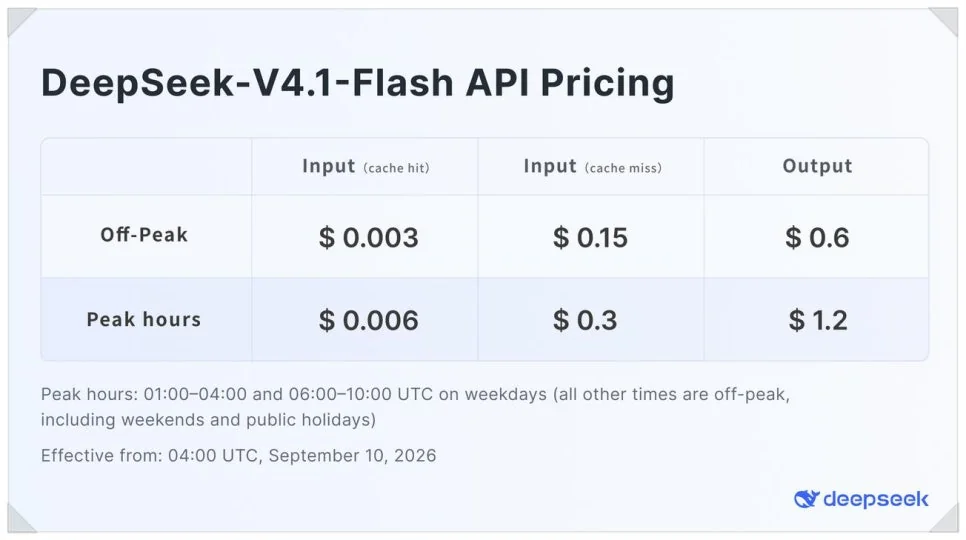
DeepSeek V4.1 Flash costs $0.15 for input and $0.60 for output off-peak, and $0.30 and $1.20 during peak hours (weekdays 01:00-04:00 and 06:00-10:00 UTC), per DeepSeek’s pricing page. DeepSeek isn’t always the cheapest option.
| Model | Input (1M) | Output (1M) | Cache hit (1M) |
|---|---|---|---|
| DeepSeek V4.1 Flash (off-peak) | $0.15 | $0.60 | $0.003 |
| DeepSeek V4.1 Flash (peak) | $0.30 | $1.20 | $0.006 |
| GPT-6 Luna (standard) | $0.10 | $0.50 | $0.010 |
| GPT-6.1 Sol (standard) | $2.00 | $10.00 | $0.100 |
| Claude Haiku 5.5 | $0.10 | $0.50 | $0.010 |
| Claude Sonnet 5.5 | $2.00 | $10.00 | $0.100 |
Cache pricing is where DeepSeek API pricing stands out. DeepSeek’s off-peak cache-hit rate is $0.003, which helps when a system reads long instructions or documents again and again.
A chatbot trading short questions and an AI agent that keeps consulting the same material have different cost structures. Which model comes out ahead depends on what you use it for.
How DeepSeek cut compute costs
DeepSeek’s low prices also come from model design. DeepSeek V4.1 Flash is a mixture-of-experts (MoE) model with 552 billion (552B) parameters. Instead of running the whole network at once, it picks only the parts a question needs, which cuts compute.
It also uses a Causal Encoder-Decoder (CED) design. The 40 layers are split into 20 encoder and 20 decoder layers, so reading a prompt and writing an answer use different amounts of compute.
In the prefill stage, where the model analyzes the input, the prompt passes through the lower 20 encoder layers, activating about 8 billion parameters per token.
The upper 20 decoder layers build the global KV, the attention memory, by projecting the encoder’s final output, which avoids duplicate computation. When it writes an answer, the model uses all 40 layers, and active parameters rise to 16 billion, according to DeepSeek’s tech report.
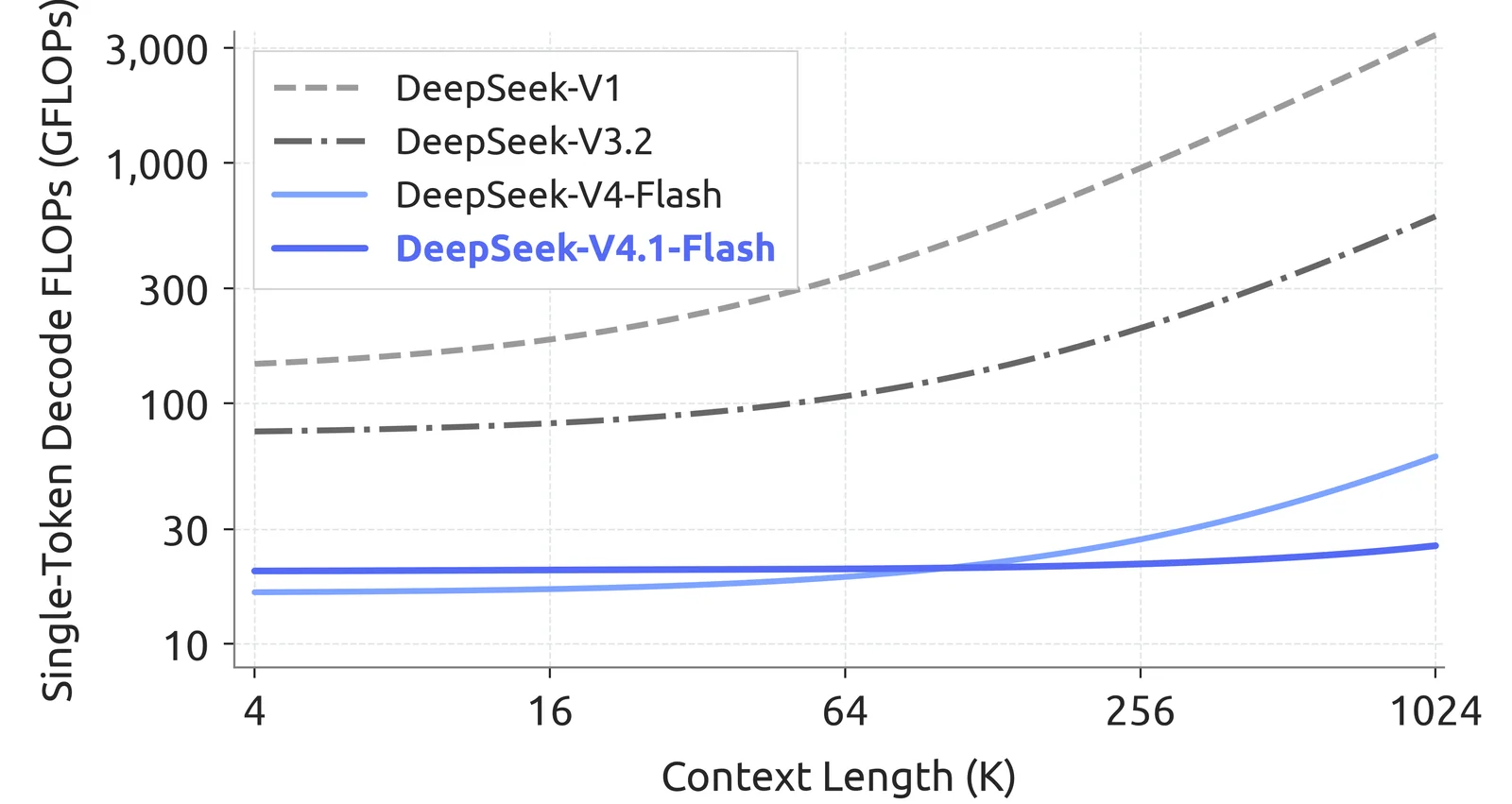
It spends less compute when reading long documents and more when writing the answer.
That design is a particular advantage for AI agents, where reading makes up a large share of the work. Lower read compute helps cut both time to first token and server costs.
KV cache compression: using less memory
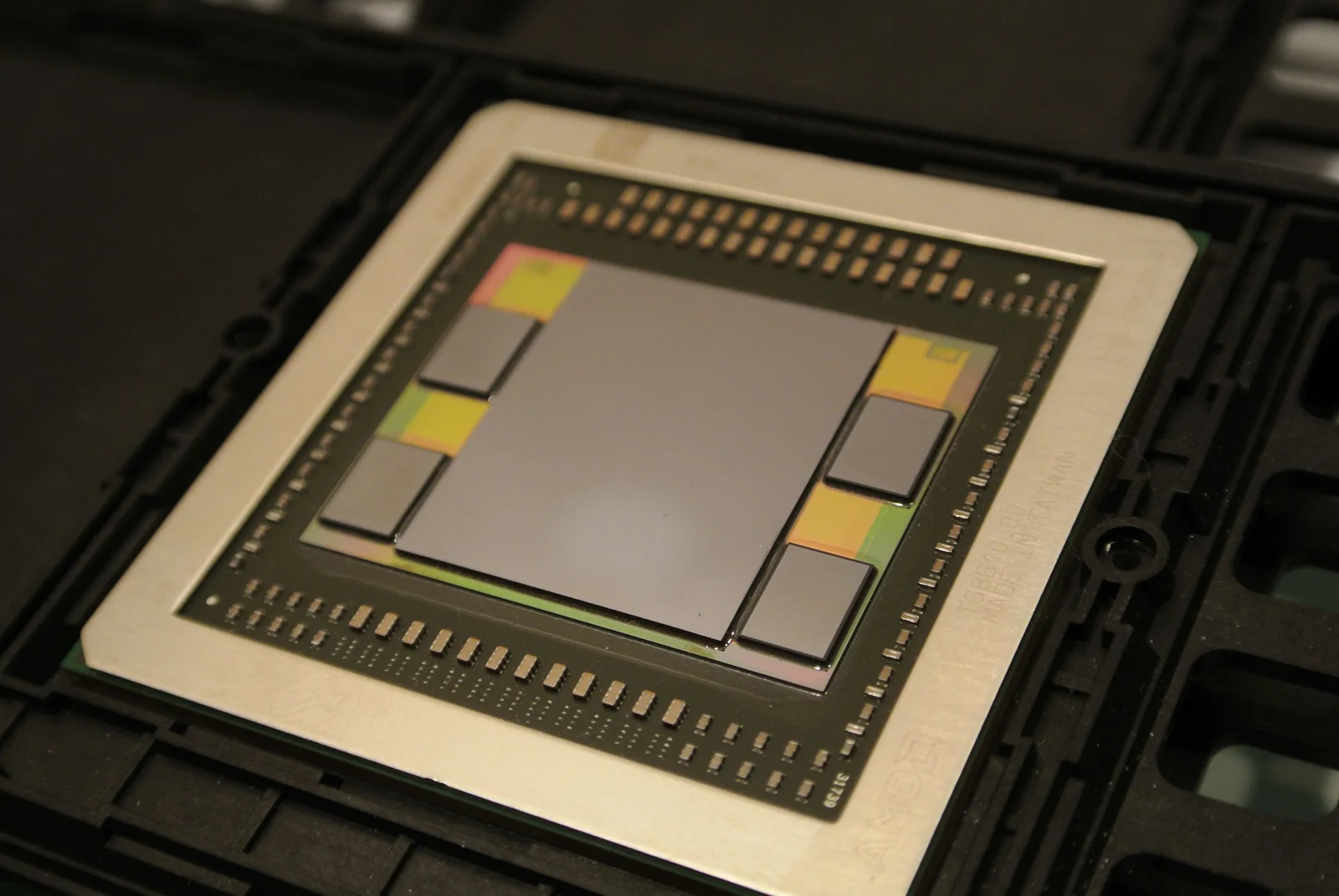
When an AI refers back to an earlier conversation or document, it uses a store called the KV cache. The longer the conversation, the more it has to keep, which strains high-bandwidth memory (HBM), the fast memory stacked next to AI chips.
DeepSeek reduced memory use with CSA2 (Compressed Sparse Attention 2) and FP4 low-precision quantization.
It also applies Reindex and Reuse techniques, so layers share existing caches and indexes instead of storing everything separately. Even in a 1-million-token context, it first finds 16,384 key candidates instead of checking every position.
By looking first where the needed information is, it skips unnecessary computation.
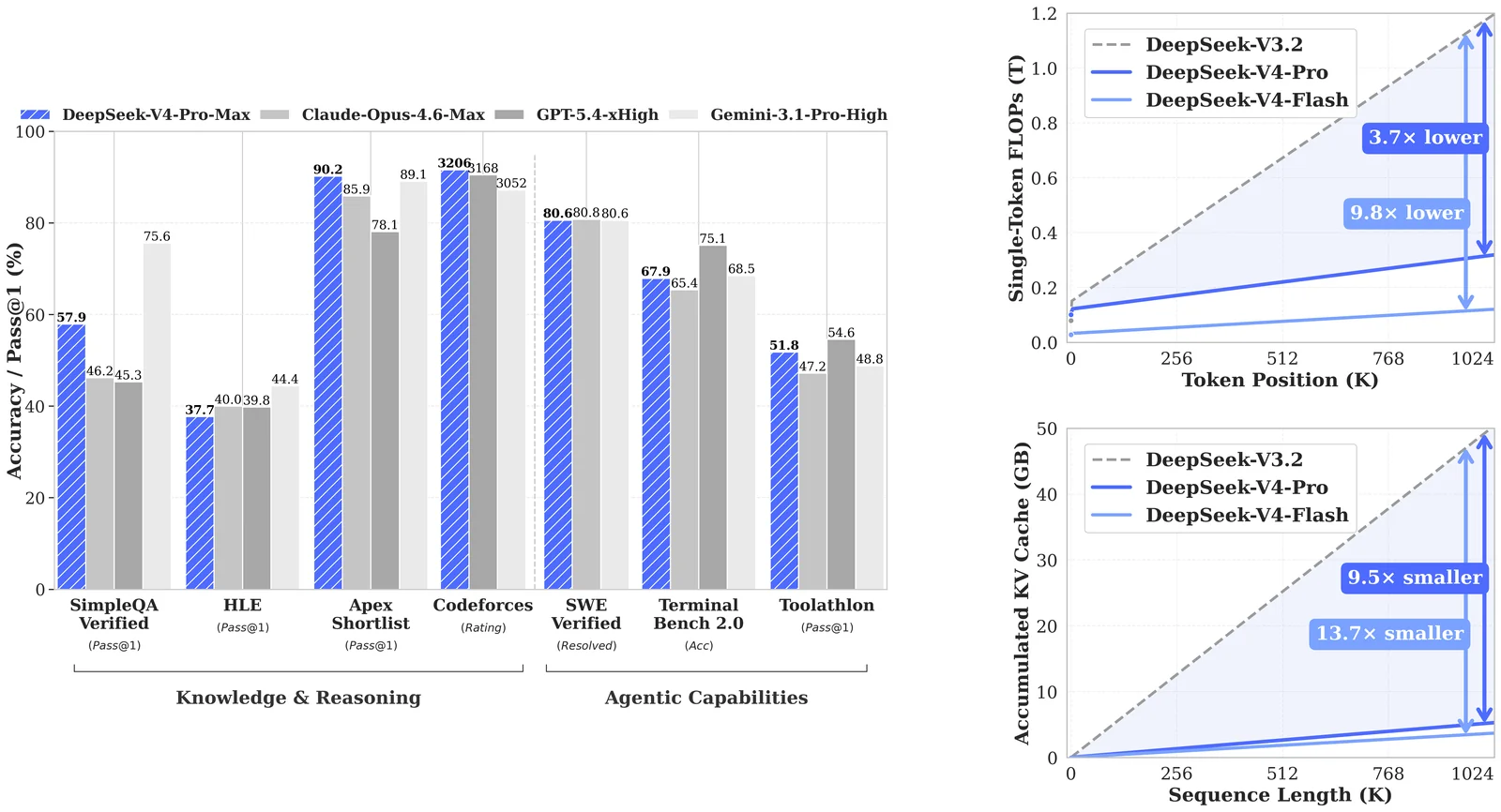
The cache is stored differently, too. The core global KV cache stays in HBM, while the rest is split across SSDs or host memory. With SWA Bounded Replay, it recomputes only the small part it needs.
That shrinks the global KV cache kept in HBM to 890 bytes per token. At 1 million tokens, that works out to about 0.9 GB.
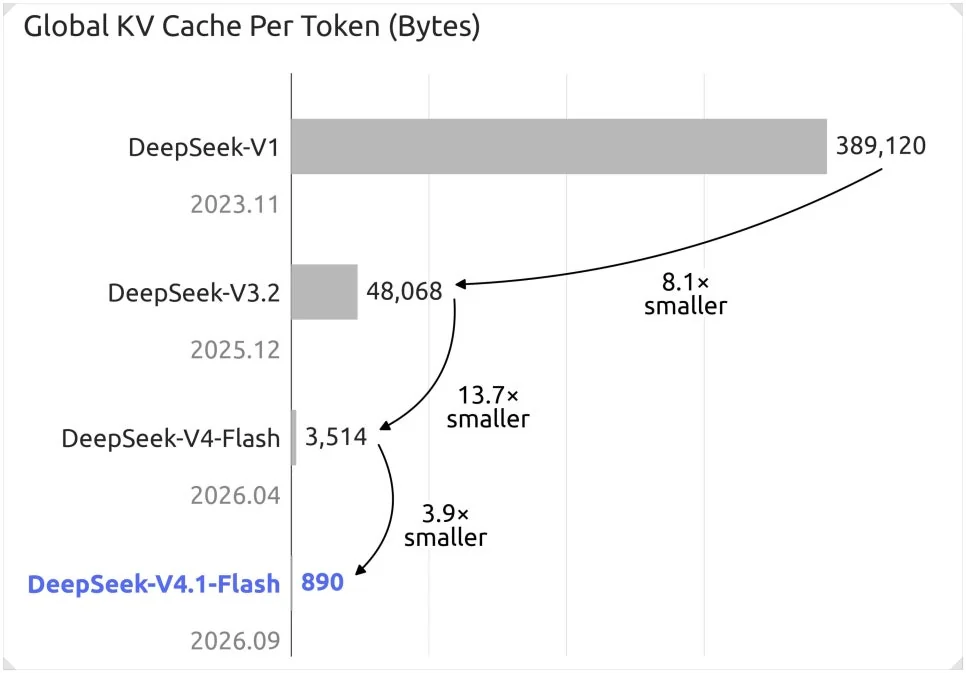
Using less memory makes it easier to handle more requests at the same time on the same servers.
DeepSeek’s API also sets a per-account concurrency limit of 2,500 requests for Flash, so it can be used in high-volume environments. A setup where the same server handles more requests also helps bring service costs down.
Will DeepSeek’s low prices pressure OpenAI and Anthropic?
With cheap AI models like DeepSeek’s on the market, OpenAI and Anthropic likely have to pay even closer attention to price.
Not every price cut is a response to DeepSeek, of course. But if similar performance is available for less, that puts pressure on the incumbents.
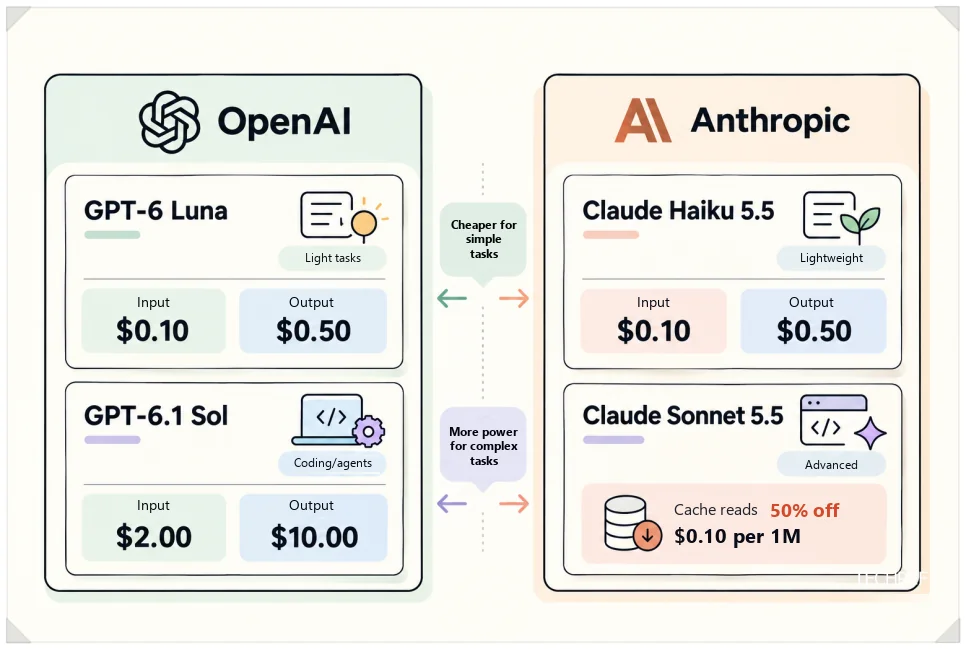
OpenAI prices GPT-6 Luna at $0.10 input and $0.50 output, and GPT-6.1 Sol at $2.00 and $10.00. That splits the lineup so you can use the cheap model for simple tasks and the higher tier for complex coding or agent work.
Anthropic offers Claude Haiku 5.5 at $0.10 input and $0.50 output. For Claude Sonnet 5.5, it cut the cache-read price by 50% to $0.10 per million tokens.
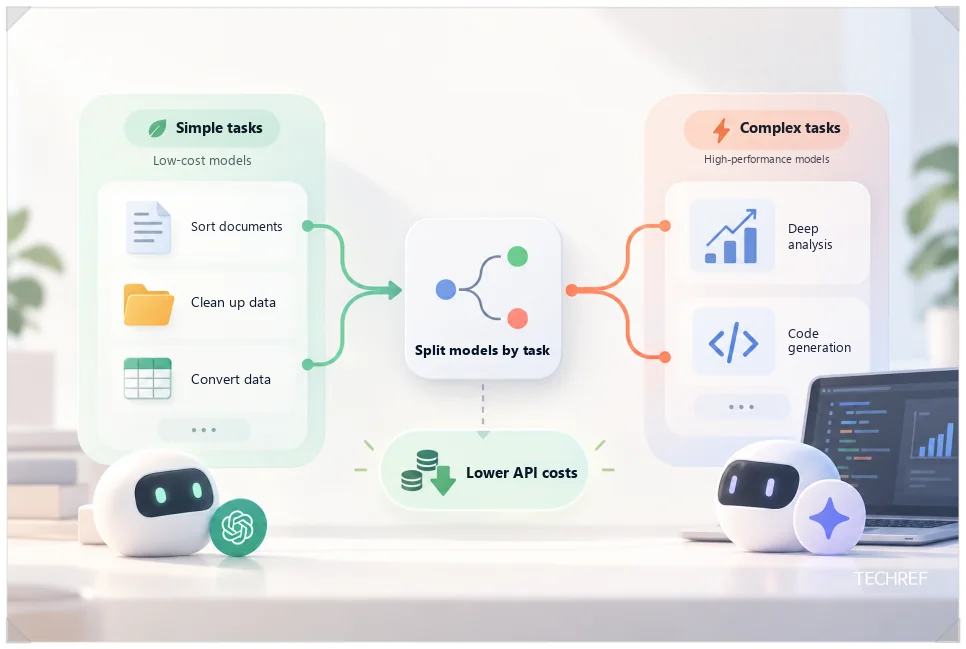
Teams running AI services now have more options. You don’t need an expensive model for everything: use a cheap model for document classification or data conversion, and a top-tier model for complex analysis or coding.
Splitting models by task this way cuts your total API bill. That’s why DeepSeek’s low-price strategy matters: it goes beyond a price fight and can change how AI services are run.
Lately, what it actually costs to finish a job has become more important than the token price. This is called cost per task.
A cheap model still gets expensive if it fails tool calls repeatedly or writes needlessly long answers. Conversely, a model with a higher token price can cost less overall if it gets the job right the first time.
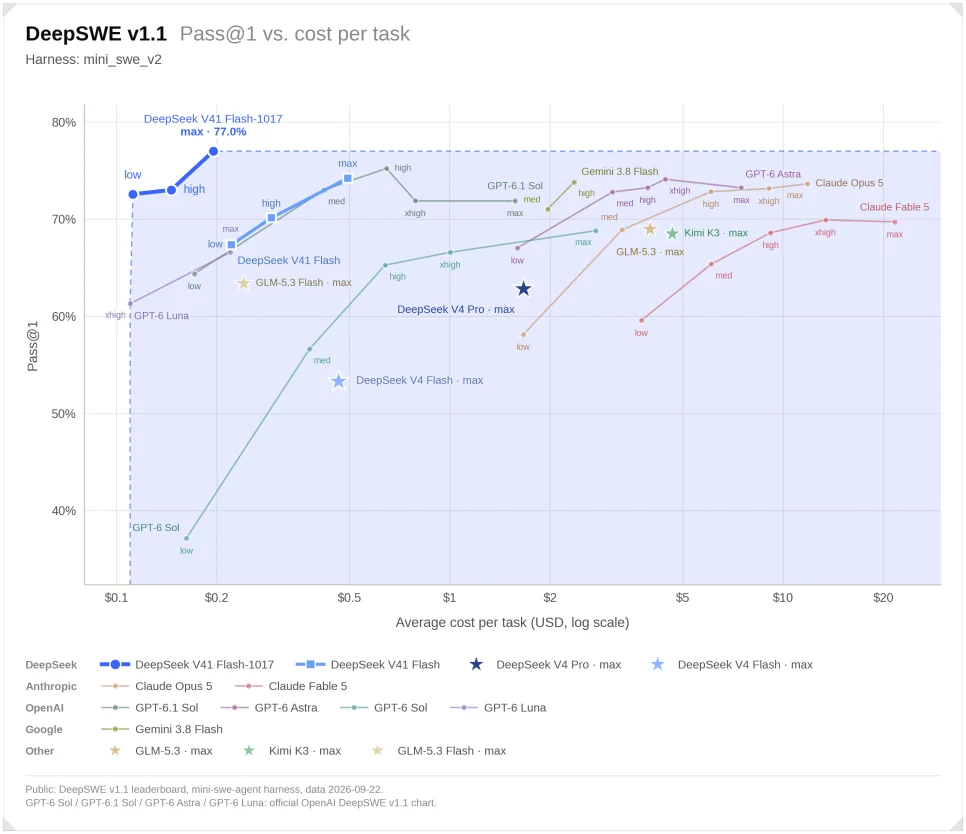
Tests on the same coding work show the difference. In Atomic Agent’s independent test, a simple coding-agent task (passing 32 hidden unit tests) was run three times. DeepSeek V4.1 Flash 1017 averaged 27 seconds and about $0.016 per task, while Claude Haiku 5.5 averaged 36 seconds and $0.011. On more complex agent tasks, the number of tool calls and retries has an even bigger effect on cost.
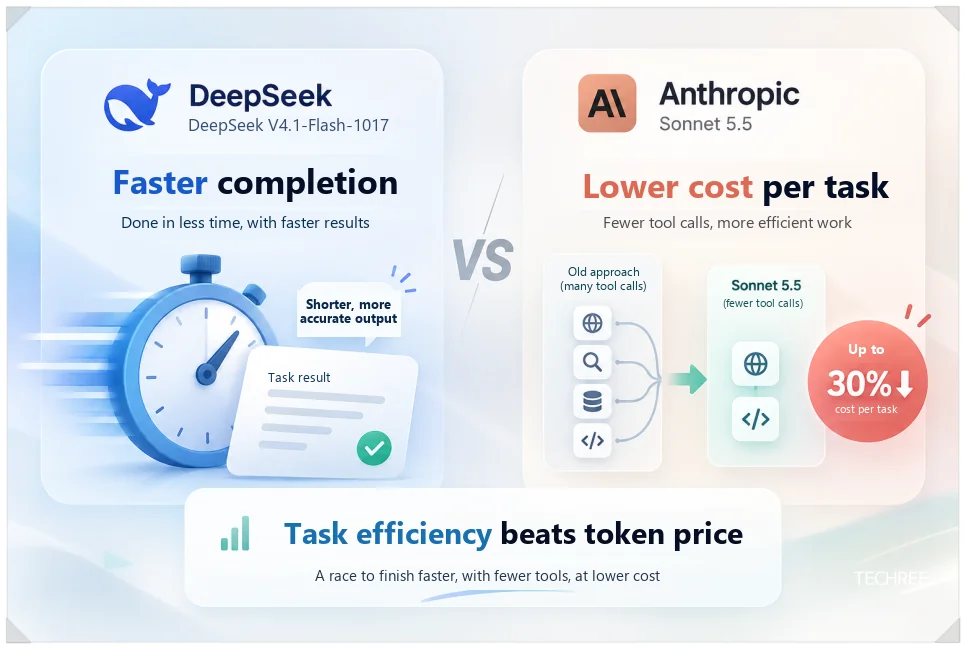
DeepSeek says its V4.1-Flash-1017 update shortened task completion times and output length. Anthropic, for its part, says Sonnet 5.5 makes fewer tool calls and costs up to 30% less per task.
Now it’s not just the token price but how quickly and accurately a model finishes the job that decides the competition.
Bottom line: pick an AI model for the job, not the price tag
DeepSeek is sharpening its cost edge with low token prices and techniques that cut compute and memory use. With OpenAI and Anthropic pushing budget models and cache discounts, AI price competition is getting fiercer.
A chatbot with lots of short questions and an AI agent that rereads long documents need different models, so the cheapest price list rarely means the cheapest bill. Rather than picking a model on DeepSeek API pricing or any other price list alone, work out what it will cost in real use.

Related reading
- Gemini 4 Argon vs. GPT-6 Astra and Claude Opus 5.5: Benchmarks and API Pricing Compared
- CXMT 4F² DRAM: Can China’s New Memory Tech Really Threaten Samsung and SK Hynix?