Claude Opus 5.5 vs Sonnet 5.5: Twice the Price, but How Big Is the Gap?
Key takeaways
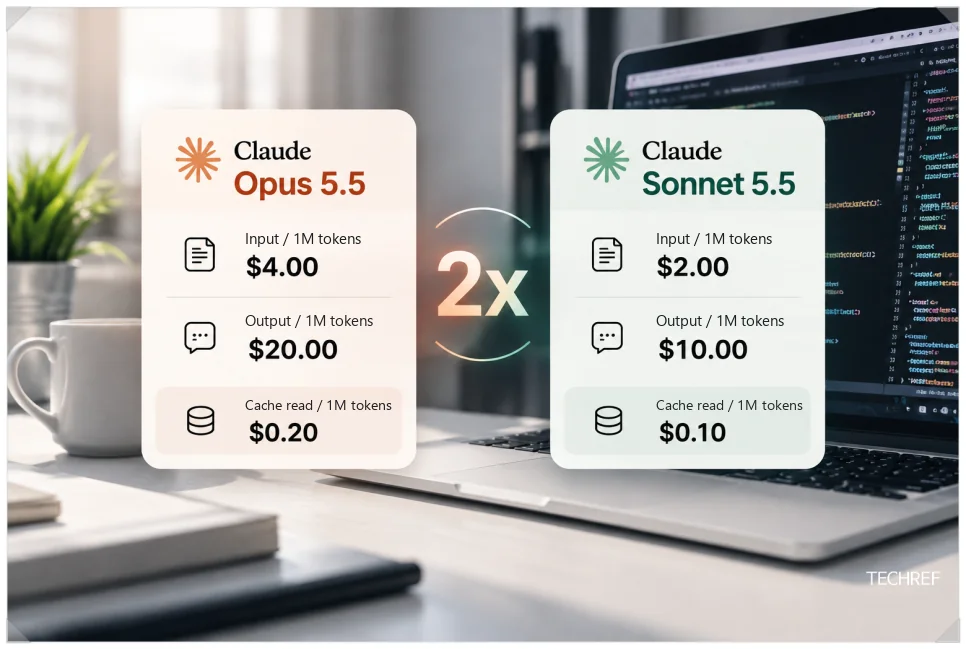
- Opus 5.5 costs $4/$20 per million tokens, exactly double Sonnet 5.5’s $2/$10.
- Benchmarks are close; Sonnet wins Terminal-Bench 4.0, Opus wins FrontierCode and Humanity’s Last Exam.
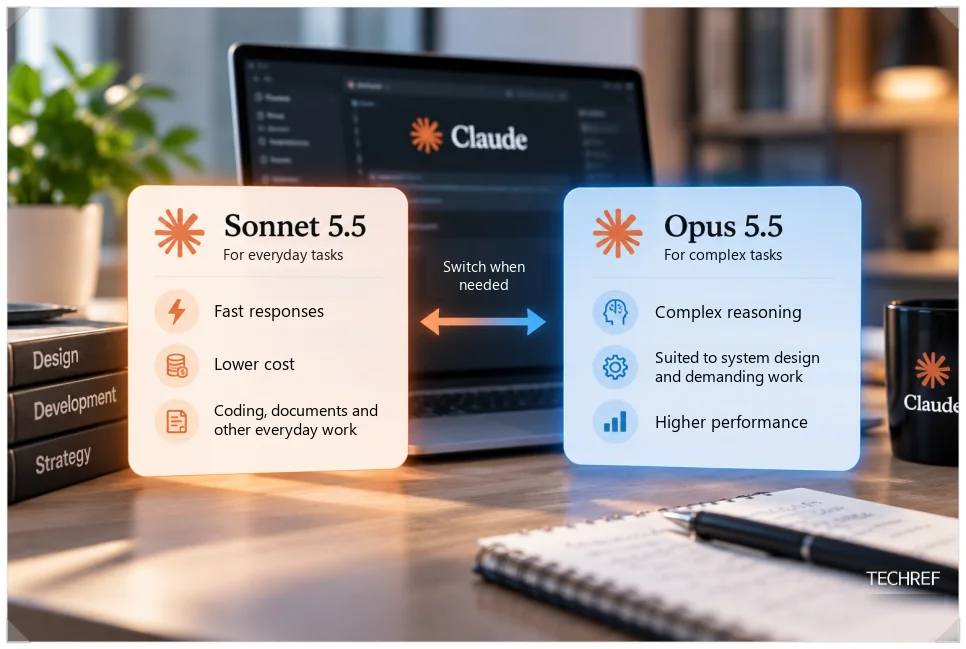
- Use Sonnet 5.5 for everyday coding and documents; switch to Opus for system design and hard reasoning.
If you use Claude regularly, you’ve probably wondered whether to pick Opus or Sonnet. Anthropic released Claude Opus 5.5 on Sept. 22, 2026, then followed with Sonnet 5.5 on Sept. 28, and this time the Opus 5.5 vs Sonnet 5.5 performance gap is much smaller than before.
The price gap is still big: Opus 5.5 costs twice as much as Sonnet 5.5 on the API. Below I compare whether the performance difference justifies that, and which model makes more sense for coding and document work.

Specs and API pricing: same limits, double the price
The two models share almost the same basic specs. Both have a 1-million-token (1M) context window, the amount of information a model can take in at once, and both can output up to 128,000 (128K) tokens, per Anthropic’s models overview.
So when you analyze a long codebase or a large document, either model can handle the same amount in one go.

The biggest difference is the API price. Sonnet 5.5 costs $2 per million input tokens and $10 per million output tokens, while Opus 5.5 costs $4 and $20. That’s exactly double on both input and output.
Prompt caching, which reuses data you send repeatedly, follows the same pattern. Cache reads cost $0.10 per million tokens on Sonnet and $0.20 on Opus (Sonnet 5.5, Opus 5.5 announcements).
Sonnet is also faster. At the highest compute setting, Artificial Analysis measures Sonnet 5.5 at 132 tokens per second and Opus 5.5 at 96. That makes Sonnet 37.5% faster, so you spend less time waiting when you iterate on code or documents.
| Sonnet 5.5 | Opus 5.5 | |
|---|---|---|
| Release date | Sept. 28, 2026 | Sept. 22, 2026 |
| Context window | 1M tokens | 1M tokens |
| Max output | 128K tokens | 128K tokens |
| Input price (per 1M) | $2.00 | $4.00 |
| Output price (per 1M) | $10.00 | $20.00 |
| Cache reads (per 1M) | $0.10 | $0.20 |
| Output speed | 132 tokens/s | 96 tokens/s |
| Plans | Free, Pro, Max | Pro, Max and up |
Opus 5.5 vs Sonnet 5.5 benchmarks: where each model wins
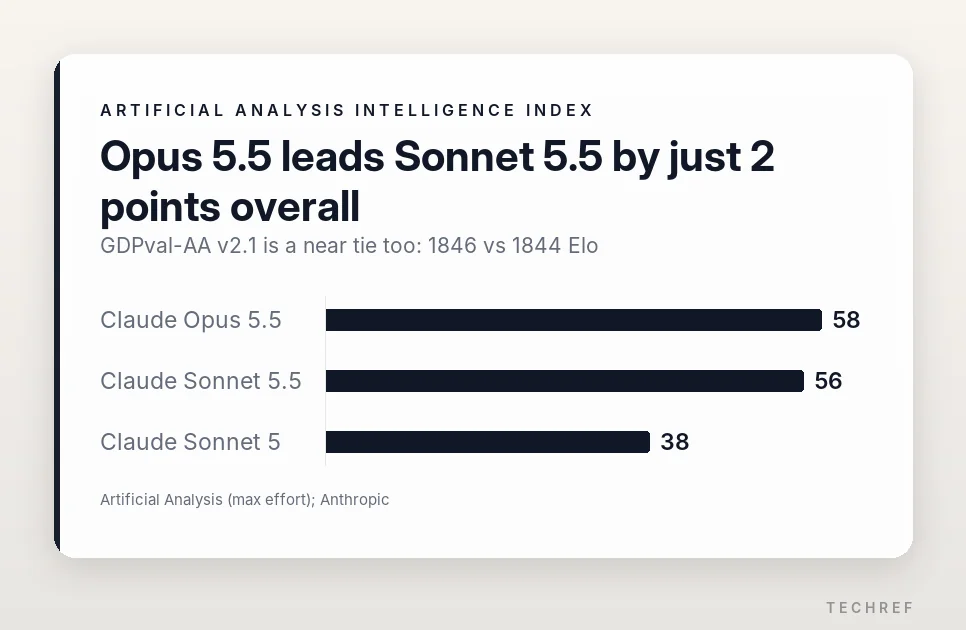
Despite the 2x price, the benchmark scores are close. On the Artificial Analysis Intelligence Index, which combines several evaluations, Opus 5.5 scores 58 and Sonnet 5.5 scores 56 at Max effort. For reference, the previous Sonnet 5 scores 38 on the same index.
On GDPval-AA v2.1, which tests professional, job-specific knowledge, they land at 1846 and 1844, practically a tie, according to Anthropic’s Sonnet 5.5 announcement.
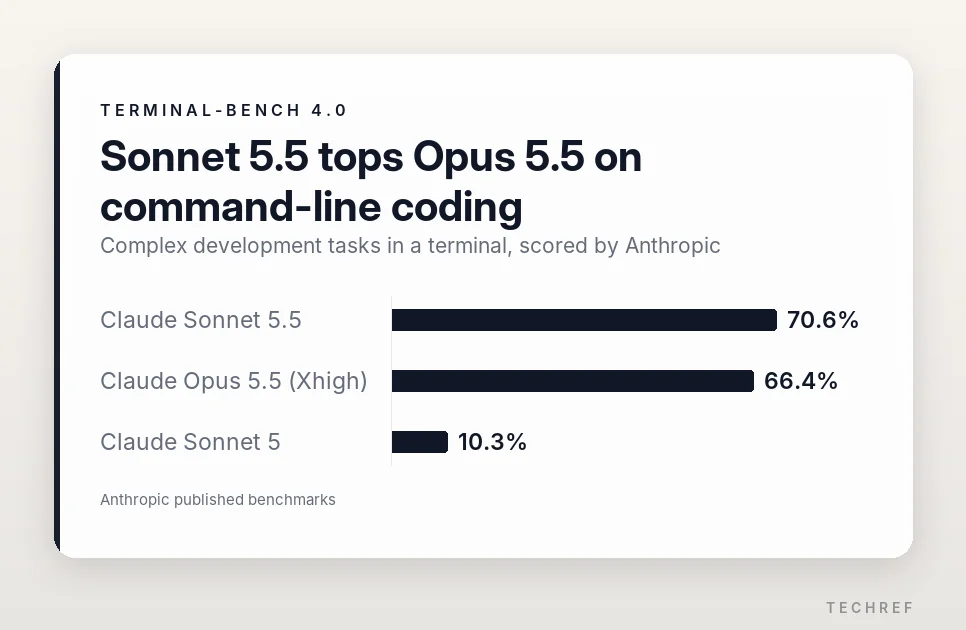
In coding, Sonnet actually comes out ahead on one test. On Terminal-Bench 4.0, which has models carry out complex development tasks in a command-line environment, Sonnet 5.5 scores 70.6%. That’s 4.2 percentage points above Opus 5.5 at its Xhigh setting (66.4%).
It’s also a huge jump from Sonnet 5’s 10.3%. Cutting unnecessary command runs and tool calls likely helped its efficiency, too.
Opus has its wins as well. On FrontierCode 1.1, which grades how complete the code is, Opus 5.5 scores 54.4% versus 52.1% for Sonnet 5.5 at Xhigh. On Humanity’s Last Exam, a hard reasoning test, Opus scores 67.7% and Sonnet 64.5%. Opus does a bit better on complex problems.
Writing shows a difference too. In AA-PersonalityBench’s style preference test, Opus 5.5 was chosen 83% of the time for vocabulary variety and 72% for natural-sounding sentences. When you need prose that flows smoothly, or writing that juggles several requirements at once, Opus can produce better results.

Coding and document work: which model to use
In practice, pick the model based on how complex the task is and how easily you can check the result. For well-scoped work such as fixing a bug in existing code, adding unit tests or wiring up a REST API, Sonnet 5.5 is often enough. It also works well for summarizing documents, analyzing data, and building tables and slides.

If you repeat similar tasks a lot, Sonnet’s speed and lower cost add up. Opus 5.5 is worth considering when you design an entire system’s architecture or need to change several modules at once. Examples include a microservices migration, which splits one system into several services, or reviewing security and legal risk.

The same rule applies in Claude Code, Anthropic’s coding tool. Opus 5.5 is the default model, but switching to Sonnet is often enough for everyday coding.
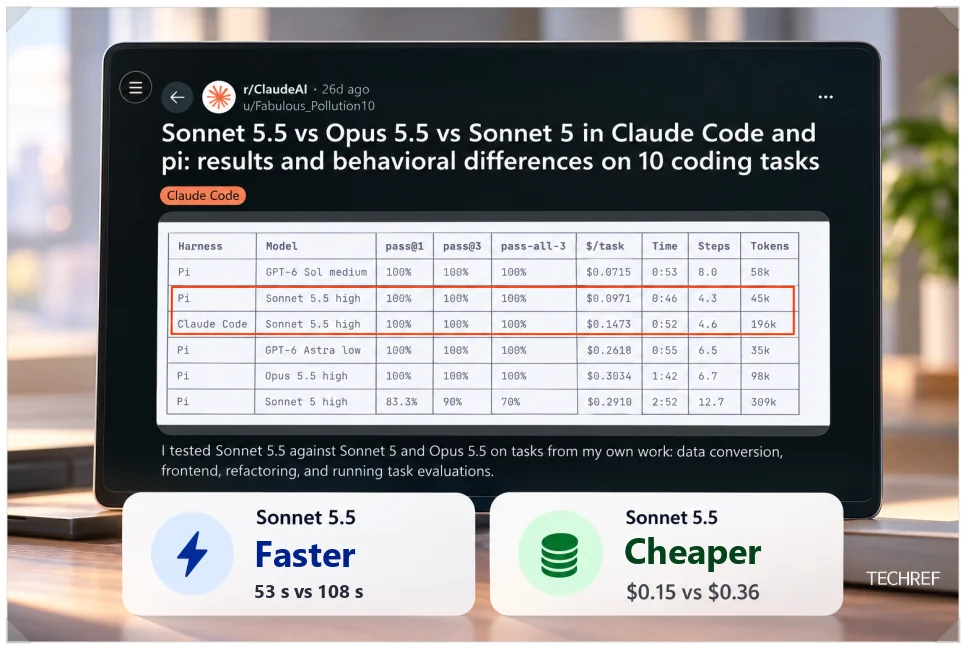
In one developer’s test posted to Reddit’s r/ClaudeAI, both models ran 10 coding tasks three times each and hit a 100% success rate. Sonnet averaged 53 seconds per run and Opus 108 seconds, and API costs were $0.15 and $0.36, making Sonnet about 58% cheaper. It’s a small test, but it shows Sonnet’s edge in speed and cost.
How to manage Claude usage limits and API costs
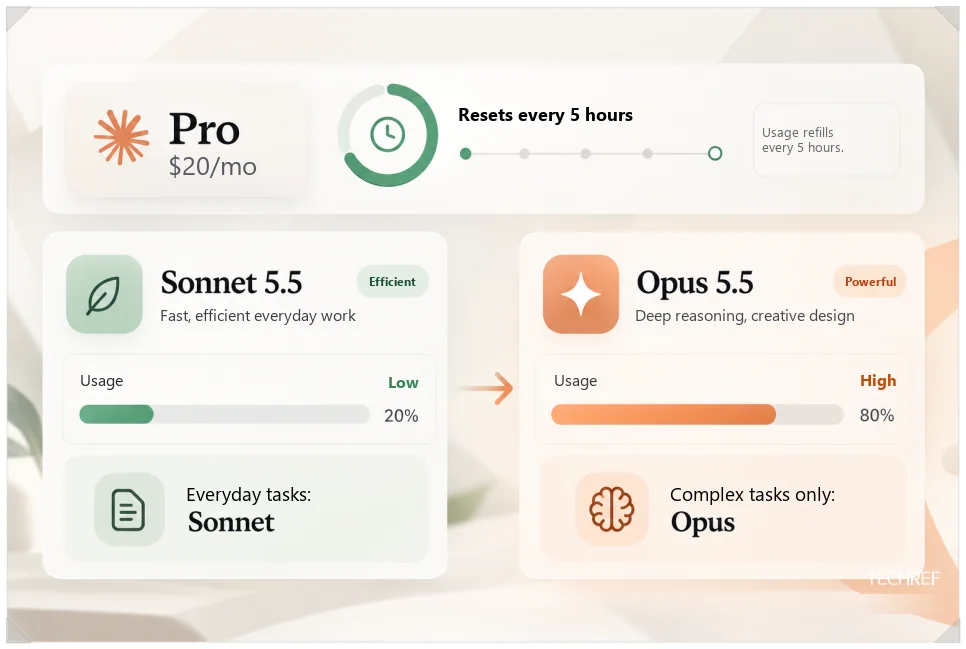
If you use Claude on the web or in the app on the Pro plan ($20/month), keep an eye on usage limits too. Limits reset on a five-hour window, so using Opus all the time gets you to the limit faster.
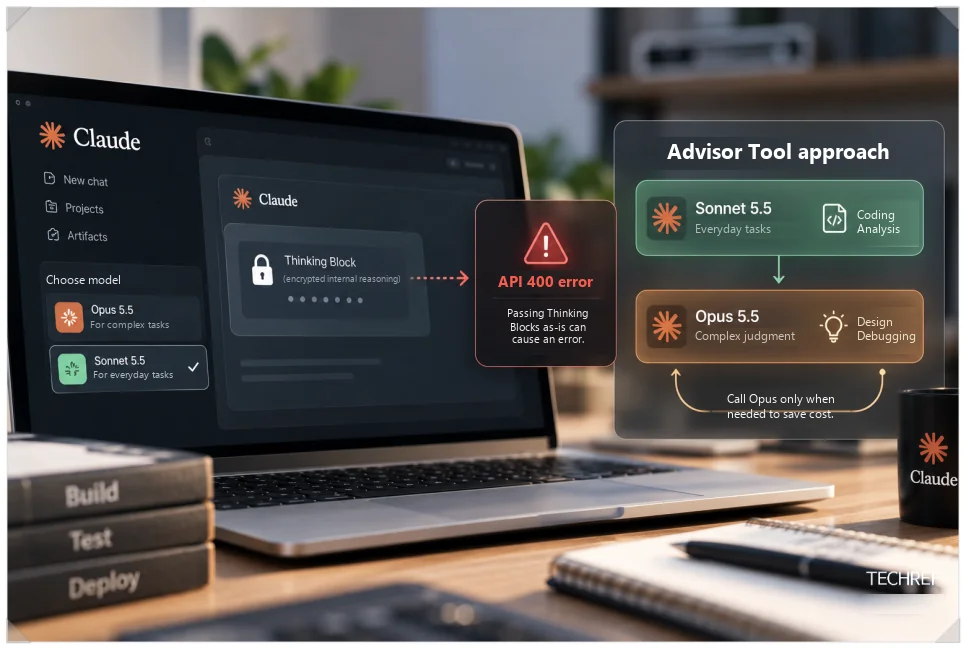
Using Sonnet 5.5 by default and switching to Opus only for complex design or reasoning helps your limit last longer.
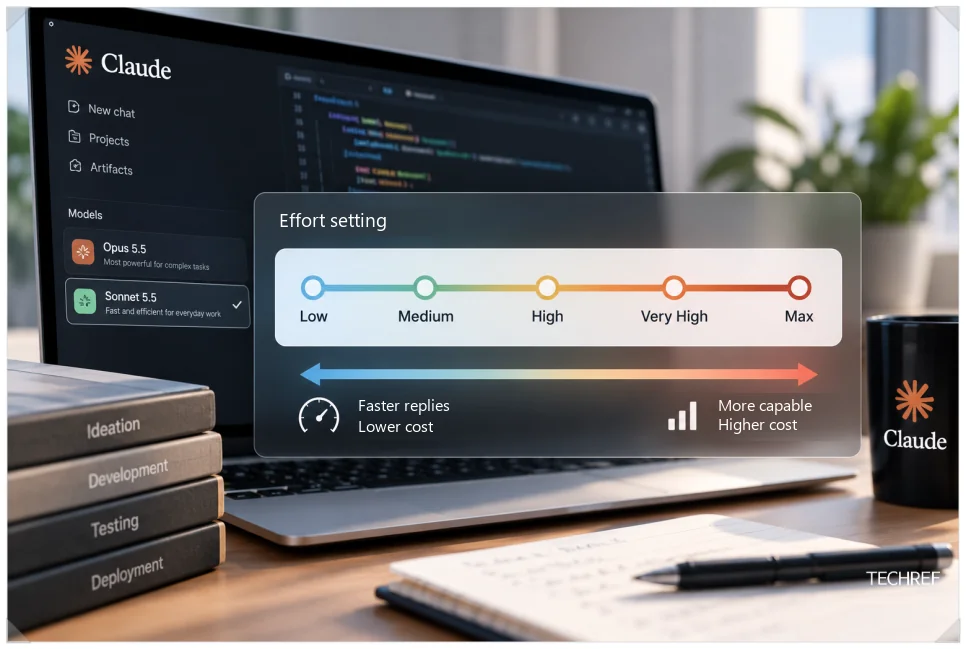
On the API, it helps to know the effort setting, which controls how much compute the model spends on reasoning. It has five levels, from Low to Max, and speed and cost change with each.
The defaults differ: a request with no effort setting runs Opus 5.5 at medium and Sonnet 5.5 at high, so set it explicitly when you compare the two. According to Anthropic, Sonnet 5.5 at Medium far exceeds Sonnet 5’s best Terminal-Bench 4.0 score for less than a tenth of the cost per task. Start at Low or Medium and step up only when tests fail or the result falls short.
There’s a catch when you switch models mid-task. The two models’ internal reasoning data, called thinking blocks, is encrypted. If you pass existing blocks straight to the other model, it may not pick up the earlier reasoning, or the API may return a 400 error.
In that case, consider the advisor tool: Sonnet runs as the main model and consults Opus only when it hits a hard decision. Splitting the work this way also cuts unnecessary API spending.
Which model should you use?
In the Opus 5.5 vs Sonnet 5.5 choice, Opus costs twice as much, but for most tasks the performance gap is small. Sonnet’s strengths are speed and low cost; Opus earns its price on complex reasoning and system design.
Make Sonnet 5.5 your default and save Opus 5.5 for the problems Sonnet can’t crack. Rather than defaulting to the most expensive model, match the model to the job and to how much you use it.
Related reading
- Gemini 4 Argon vs. GPT-6 Astra and Claude Opus 5.5: Benchmarks and API Pricing Compared
- OpenCode vs Oh My OpenCode: Differences, Setup and How to Use Them