Gemini 4 Carbon: Google’s Security AI That Finds and Fixes Vulnerabilities
Key takeaways
- Gemini 4 Carbon is Google’s security-focused model, built to find, verify and patch vulnerabilities.
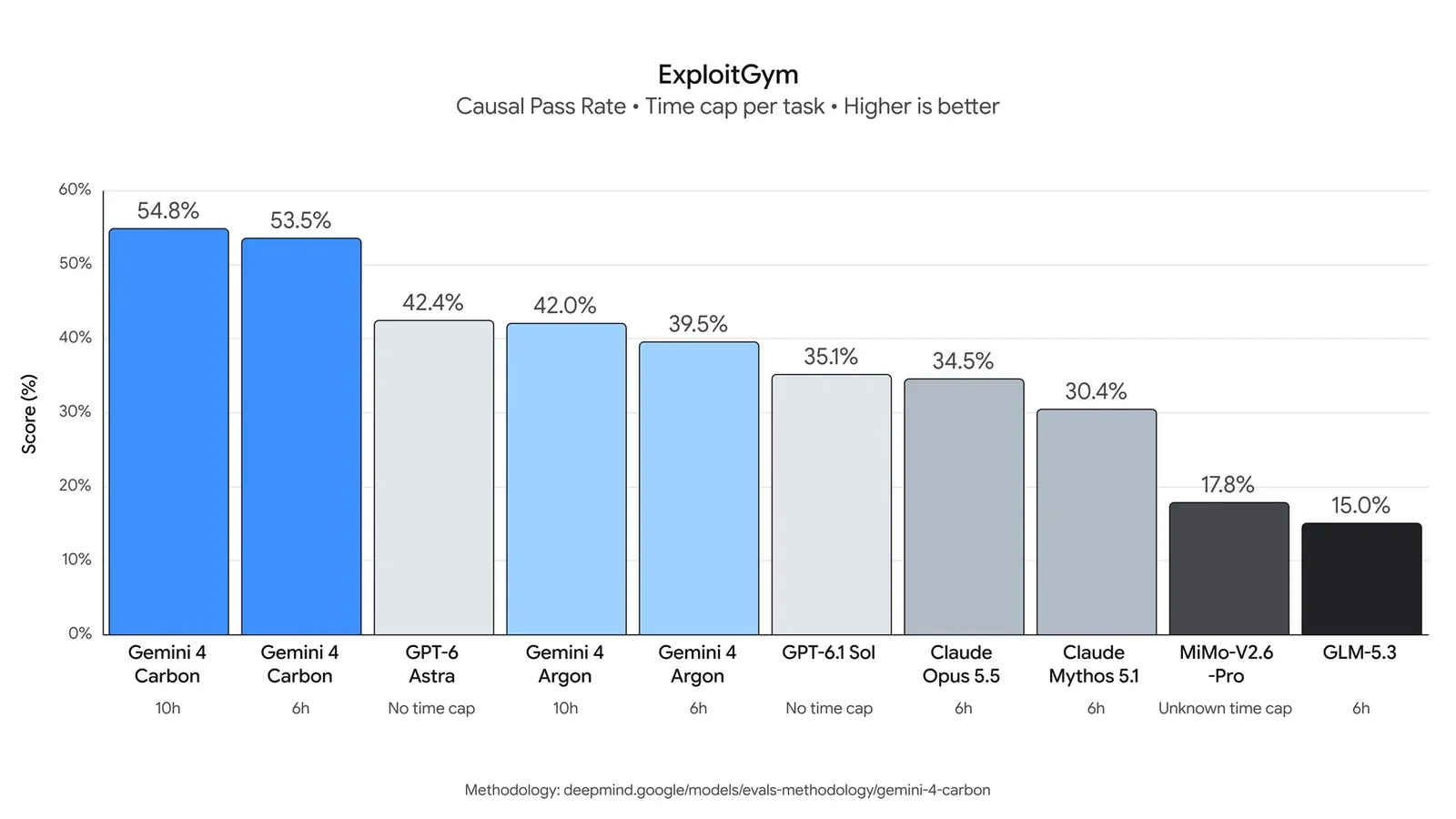
- It leads SEC-bench Pro at 88.2% and ExploitGym at 54.8%, but hallucinates more than Argon.
- Access is limited to Fairwind partners; intro API pricing is $2/$10 per million tokens.
Google DeepMind’s Gemini 4 Carbon, announced on Oct. 28, 2026, is a model built for security work: it hunts for vulnerabilities and writes the fixes. More developers write code with AI now, and that’s faster, but checking the result for security problems still takes a lot of manual work.
Carbon arrived just two weeks after Gemini 4 Argon, Google’s general-purpose model, and it is tuned for a narrower job.
How Gemini 4 Carbon differs from Argon
Argon covers general coding and reasoning. Carbon focuses on finding and fixing bugs in complex system code. It’s designed to trace root causes across tens of thousands of lines and keep debugging over long sessions.
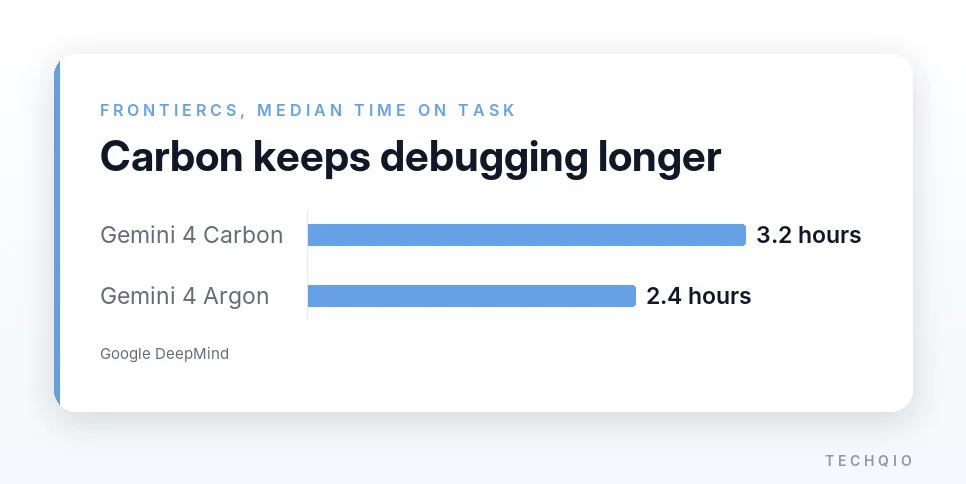
On FrontierCS, which measures how long a model keeps working on a task, Carbon posted a median of 3.2 hours versus Argon’s 2.4. Its median time to first code was 0.61 hours, which suggests it spends its time on the root cause and the runtime environment rather than writing code fast.
It’s multimodal, handling text, images, video and audio. With a 1-million-token context window, it can keep many files and earlier work in view at once, which helps on large projects with many files and complex structure.
How Gemini 4 Carbon scores on finding and fixing vulnerabilities
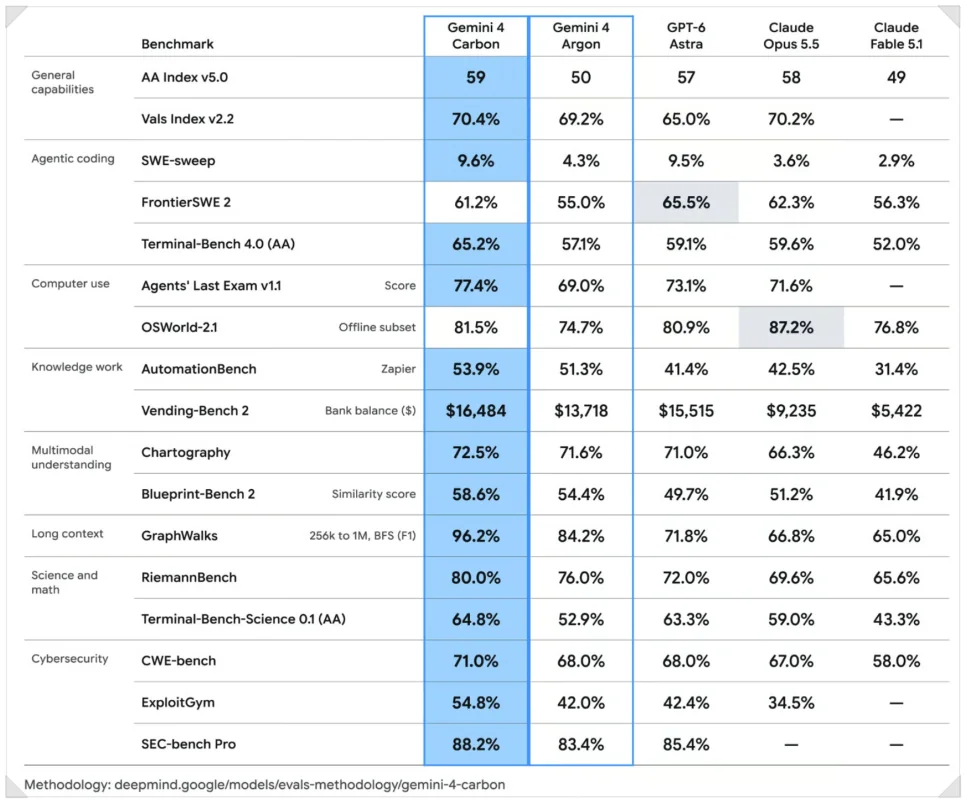
Finding a vulnerability doesn’t solve it. You need to confirm it can actually be exploited, then patch it without breaking existing features. Carbon was measured on all three: detection, exploitability and patching, in Google DeepMind’s published results.
| Benchmark | Carbon | Argon | GPT-6 Astra | Claude Opus 5.5 |
|---|---|---|---|---|
| Overall intelligence (AA v5.0) | 59 | 50 | 57 | 58 |
| Vulnerability detection (SEC-bench Pro) | 88.2% | 83.4% | 85.4% | Not disclosed |
| Exploitability (ExploitGym) | 54.8% | 42.0% | 42.4% | 34.5% |
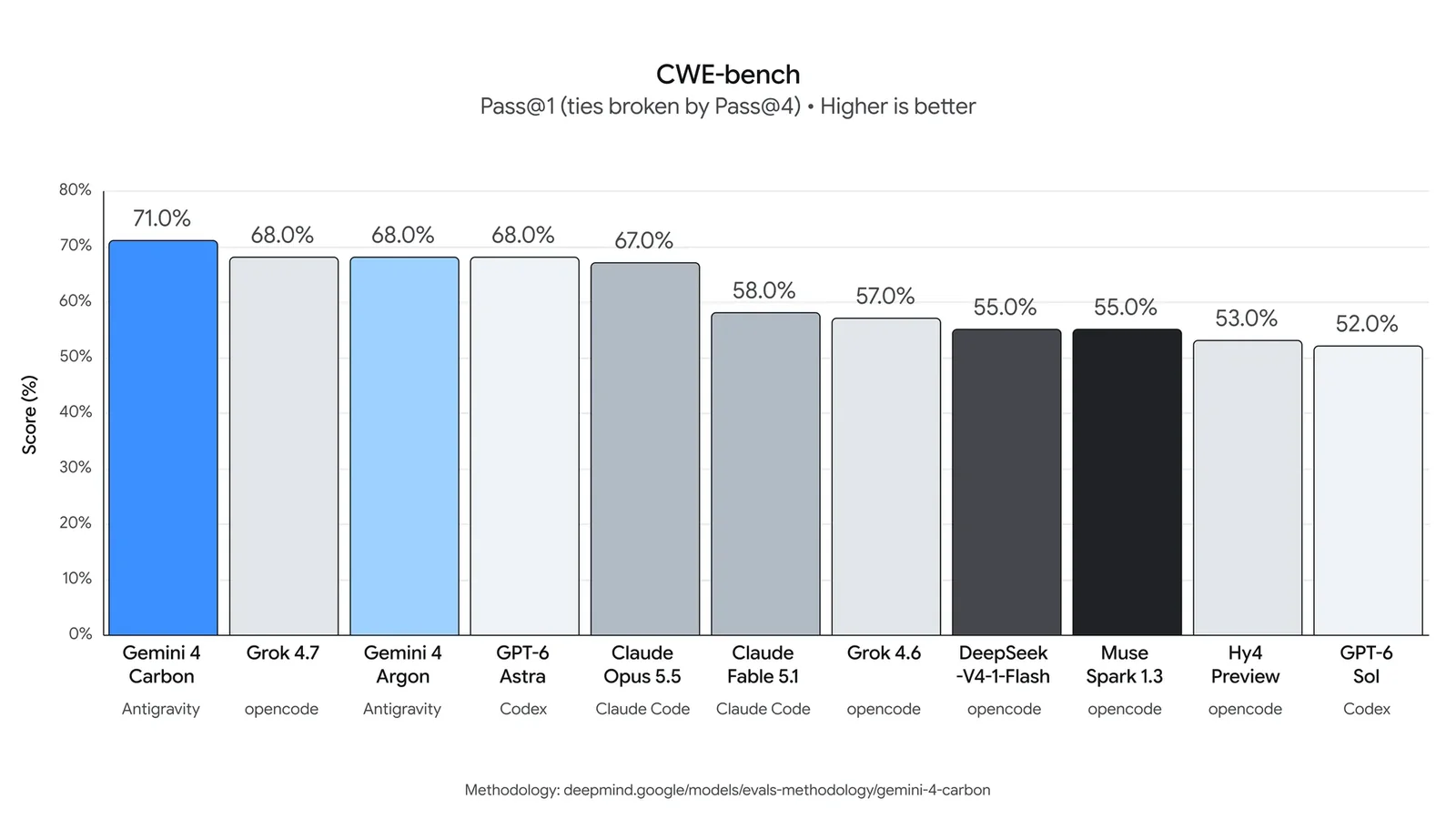
| Patching (CWE-bench) | 71.0% | 68.0% | 68.0% | 67.0% |
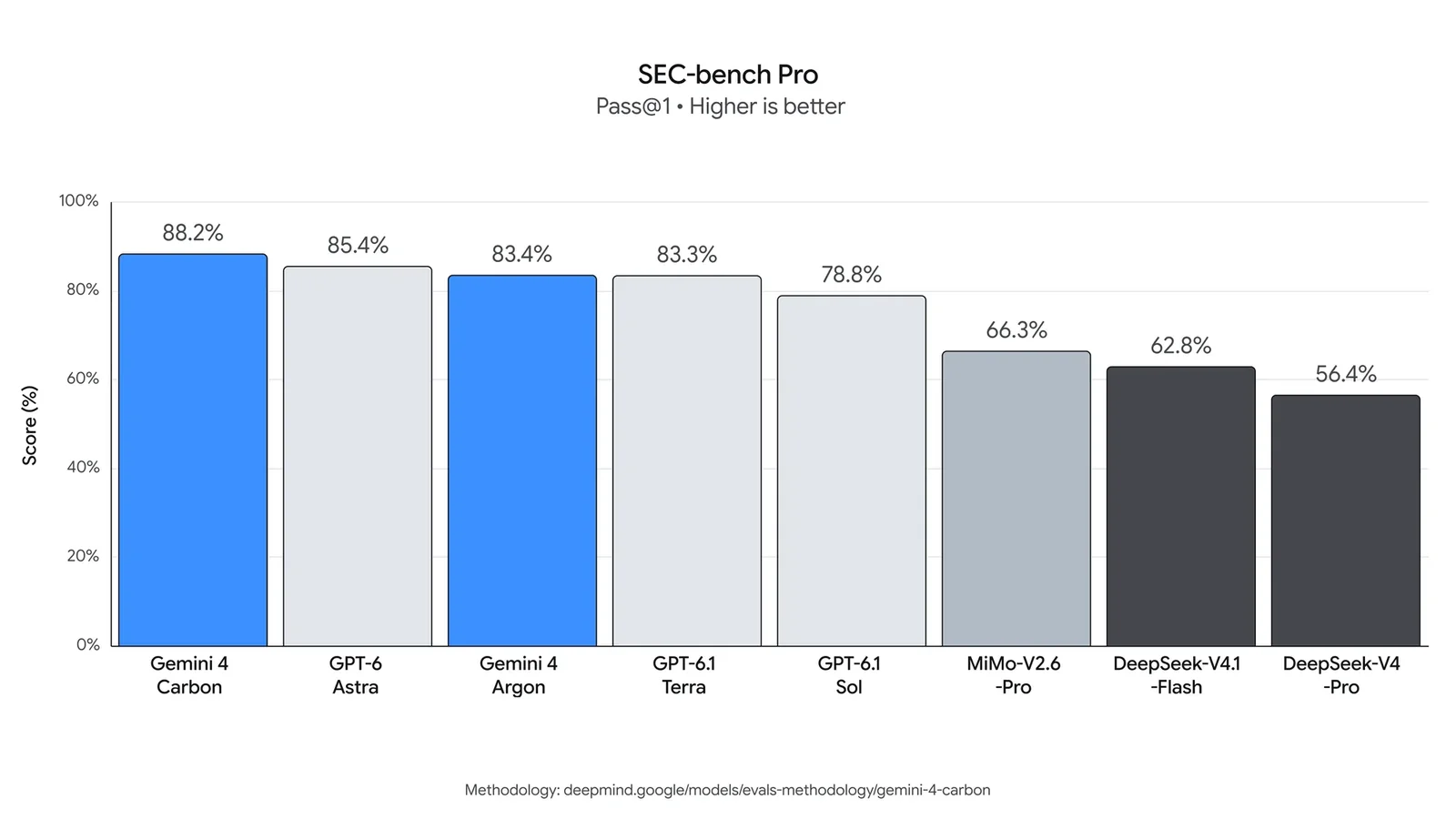
On SEC-bench Pro, which targets the Linux kernel and the V8 engine, Carbon scored 88.2% in Google’s SEC-bench Pro results. On ExploitGym, which tests real exploitability, it hit 54.8%, more than 12 percentage points ahead of the other models compared.
It scored 71.0% on CWE-bench for patching and ranked first on the Artificial Analysis Intelligence Index v5.0 with 59. Google’s Chrome team found it more than 10x better at generating high-quality patches than another lab’s frontier model, and Wiz reported leading results on web penetration tests. Beyond security, Carbon ranks fourth on WebDev Arena at 1768 Elo, up 89 points.
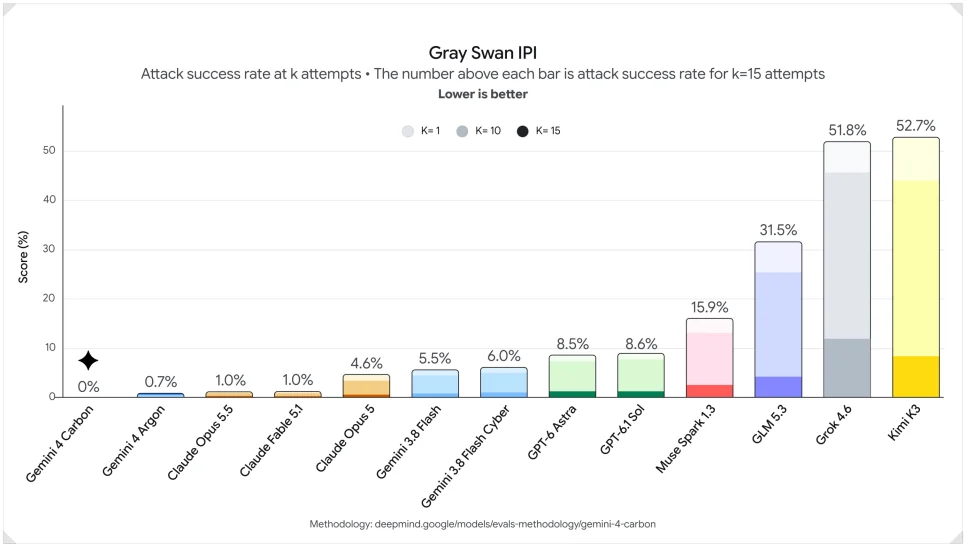
On Terminal-Bench 4.0, its successful cheating rate was 0.0%, and it blocked 100% of attacks in Gray Swan’s prompt-injection test.
The hallucination rate, though, was 11%, higher than Argon’s 4%. That’s well below the 50%-plus of rival models, but you should still review Carbon’s fixes rather than apply them as is.
Why Google isn’t releasing it to everyone
Carbon isn’t yet an API anyone can call. A model that finds vulnerabilities is useful to attackers too. A technology that serves both defense and offense like this is called dual-use.
Google’s internal analysis found that releasing a model without safeguards could make reproducing past major cyberattacks 16.7x cheaper. Given that risk, Google is offering Carbon through the Fairwind Program to government agencies, critical infrastructure operators and vetted security companies.
Participating organizations go through background checks, and model access is limited to their internal security teams. Phishing-resistant multi-factor authentication (FIDO2) is required, and creating or redistributing malware is prohibited.
On Hacker News, some people were disappointed that Google announced the model without a general release. Still, for a model that analyzes vulnerabilities directly, widening access only after enough testing is understandable.

Gemini 4 Carbon API pricing
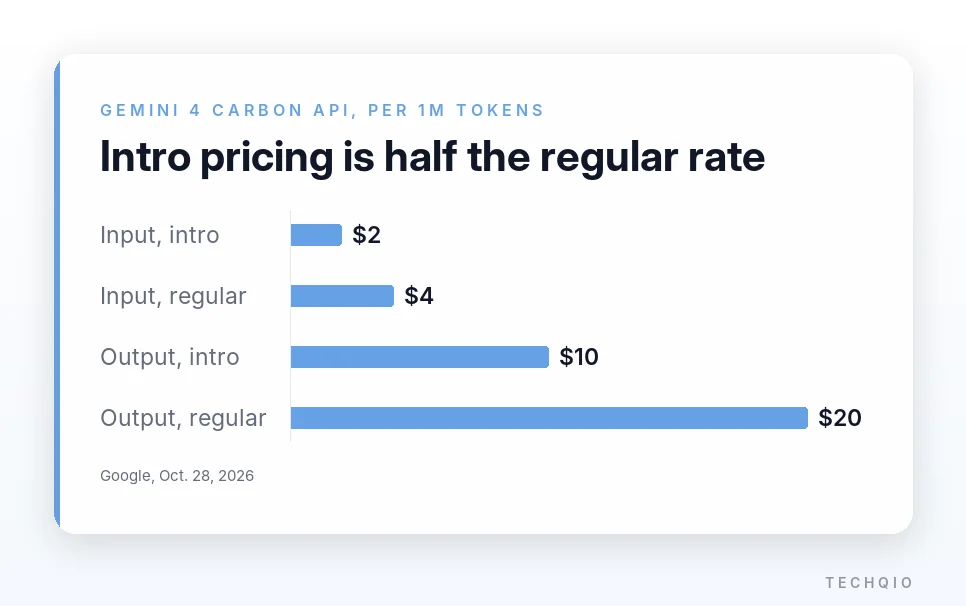
Introductory pricing is $2 per million input tokens and $10 per million output tokens. Cached input is 95% off the input price, and after the promotion the regular rate is $4 input and $20 output.
Real costs depend on volume as well as per-token price. Carbon works through problems in many steps and uses more than 120,000 output tokens per task on average, so repeated security scans can cost more than you’d expect. An API for general developers and businesses will roll out gradually, based on feedback from the first participants.
Can you hand AI the security review?
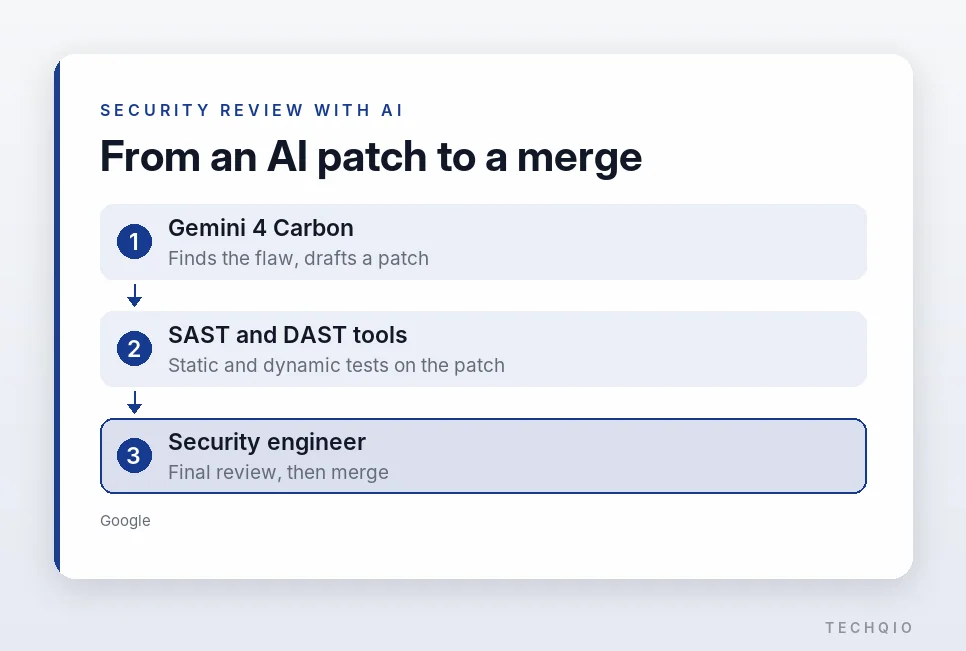
What stands out about Carbon is that it finds vulnerabilities in code and proposes fixes. Where earlier AI coding tools focused on writing code, Carbon can check the code that’s already written for security problems.
General developers can’t use it yet, but expect more AI-driven security checks. Because these results came from research conditions with safeguards removed, real projects still need existing tools such as static analysis (SAST) and dynamic testing (DAST), plus a final review by a person.
Frequently asked questions
Gemini 4 Carbon is not open to individual developers yet, and how it ranks on coding depends on the benchmark.
Can I use Gemini 4 Carbon with a personal account today?
Not yet. Google is testing it first with Fairwind security partners, and general API access will follow in stages.
Is Gemini 4 Carbon better at coding than Claude Opus 5.5 or GPT-6 Astra?
It depends on the job. Carbon is strong at finding and fixing vulnerabilities, but on the coding agent index Claude Opus 5.5 scored 62 to Carbon’s 59. In Google’s own benchmark table, GPT-6 Astra scored highest on FrontierSWE 2, while Carbon led Terminal-Bench 4.0. Compare general code writing and specialized security analysis separately.

Related reading
- Gemini 4 Argon vs. GPT-6 Astra and Claude Opus 5.5: Benchmarks and API Pricing Compared
- PHP2Shell Vulnerability: The 14-Year-Old PHP Flaw AI Found and How to Patch It